
Haiti gang outreach stops short of a disarmament agreement
Haiti’s disarmament commission has acknowledged contact from a representative of 400 Mawozo. The available reporting does not establish a weapons handover or agreement, while the commission says any dialogue must follow the government’s roadmap.
Radio Télé Olé Haïti · AI-assisted editorial draft · Updated 11/18/2026
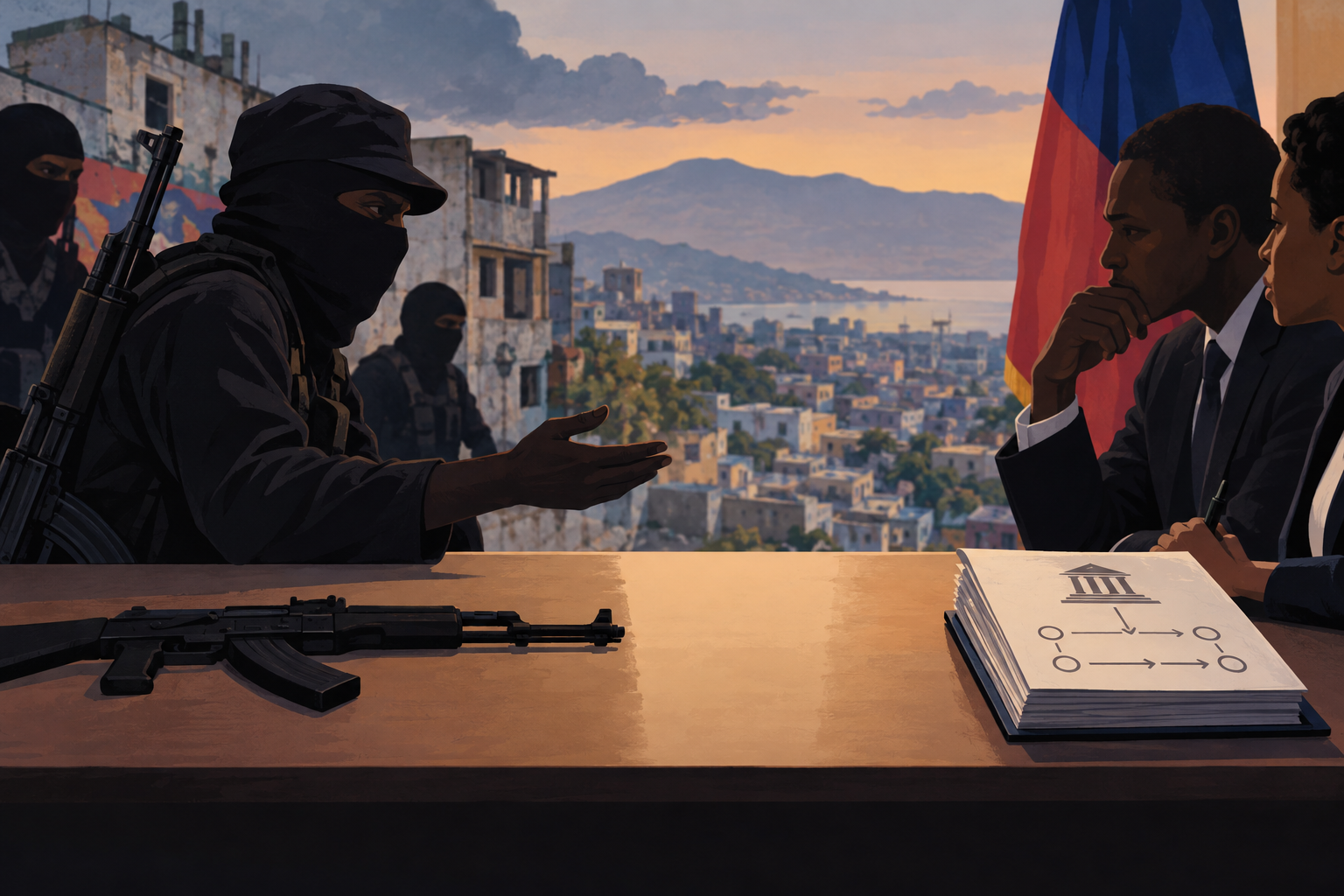
AI-generated editorial illustration — not a documentary photograph
Contact confirmed, outcome unresolved
Haiti’s disarmament commission has confirmed that someone representing the 400 Mawozo gang contacted it, according to the Associated Press. The acknowledgment establishes an approach to the commission, but the supplied reporting does not establish agreed negotiations, a ceasefire or a weapons handover. The commission told AP that any dialogue must follow the government’s roadmap. Associated Press
AP reported the confirmation following the gang’s November 6 announcement. The distinction between an announcement and an independently acknowledged contact matters: the commission corroborated that an approach occurred, not that the parties had reached an agreement. As of the November 9 research cutoff, the evidence supplied for this report supports describing an opening for contact rather than a security breakthrough. Associated Press
An existing surrender framework
The approach came against an already stated disarmament position. Le Nouvelliste reported on November 6 that the commission had called on armed-group members to surrender their weapons and use legal reintegration mechanisms. The underlying communiqué, dated November 4, also warned that continued criminal activity would face prosecution. Le Nouvelliste
That appeal provides context for the commission’s response to 400 Mawozo. Its publicly reported position combines an invitation to disarm with a warning about criminal accountability. It should not be read as evidence that the commission accepted terms proposed by the gang: the supplied reporting establishes the appeal and the contact, not a negotiated settlement. Le Nouvelliste and Associated Press
The two news organizations substantiate different parts of the picture. AP directly checked the particular contact with the commission. Le Nouvelliste separately documented the commission’s surrender appeal; its report does not independently confirm the 400 Mawozo approach. Keeping those findings separate avoids overstating the corroboration available for the latest development.
UN receipt is not endorsement
A separate approach to the United Nations also requires careful qualification. At its November 3 briefing, the UN acknowledged receiving a letter from gang leader Wilson Joseph. The spokesperson distinguished receipt from endorsement of either the author or the letter’s contents, and from any agreement to respond. UN briefing transcript
The UN acknowledgment therefore should not be presented as acceptance of talks. Nor does it establish a shared negotiating process with Haiti’s disarmament commission. The available records describe separate communications, with different institutions stating limits on what their acknowledgment means. The briefing transcript is machine-generated and carries an accuracy disclaimer, making its wording a further point for human review. UN briefing transcript
Military pressure, different mandates
The outreach unfolded amid a major Salvadoran deployment. AP reported on November 4 that El Salvador had sent more than 2,000 troops following the disappearance of four Salvadoran aviation technicians in an October 18 attack. Haitian police reported finding their burned vehicle, but not the men. That account establishes their reported status on November 4, not necessarily at the later research cutoff. Associated Press
The UN said on November 3 that the vast majority of Salvadoran personnel were outside the international gang-suppression force it supports. The deployment therefore cannot accurately be described wholesale as a UN operation. United Nations
The central unresolved question is whether acknowledged outreach can produce accountable disarmament. For now, the documented development is narrower: a gang representative made contact, and the commission reiterated that dialogue must follow the government’s framework. Any claim of a ceasefire, surrender or settlement would require additional evidence. Associated Press
Sources & references
- Reporting on 400 Mawozo’s contact with Haiti’s disarmament commission
Associated Press
- La CNDDR appelle les groupes armés à déposer les armes
Le Nouvelliste · 2026-11-06
- United Nations spokesperson briefing, November 3, 2026
United Nations · 2026-11-03
- Reporting on Salvadoran deployment and missing aviation technicians in Haiti
Associated Press · 2026-11-04
- UN account of gang outreach and the Salvadoran military offensive in Haiti
United Nations